
Description
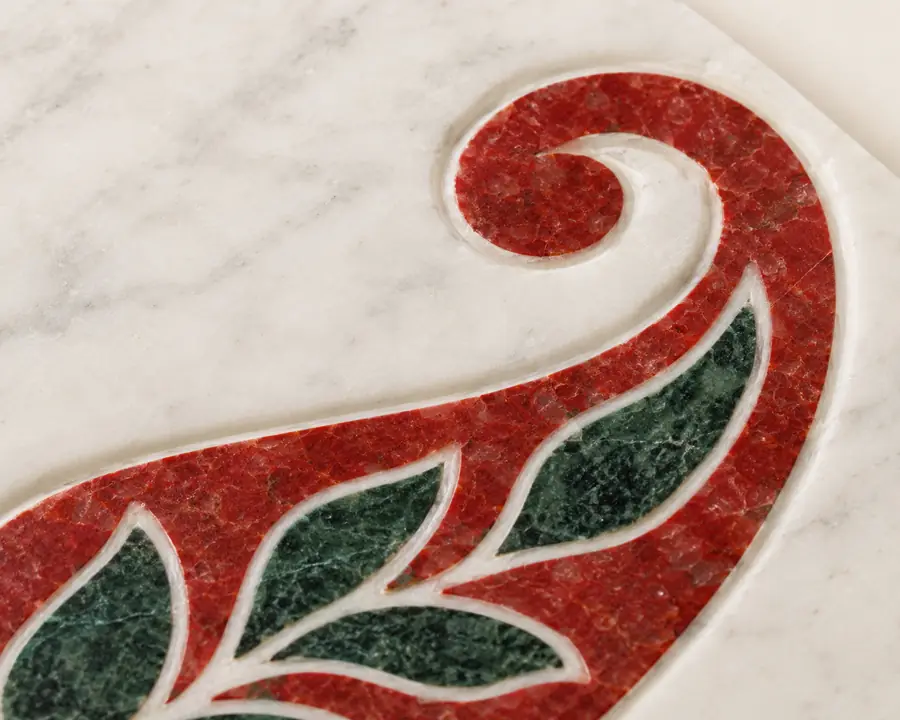
Paisley detail concentrated at the corners
This paisley marble panel places two red and green inlaid motifs at the corners of a white rectangle. Keeping the decoration near the edges creates a different rhythm from a densely patterned inlay panel and makes the surrounding border part of the composition.
Decide which corners should lead
Review the intended orientation with the maker, especially if the panel will sit beside another artwork or be set within furniture. The suggested 45 × 30 × 2 cm dimensions are indicative; confirm the visible artwork size after allowing for any frame or recessed edge.
White marble is proposed for the background. The red and green materials, joints and surface finish need to be chosen before making. For wall display, specify a frame and suitable fixing; for an insert, provide the supported recess drawing. This illustrated design is not specified for flooring or food preparation.
Order around the final arrangement
Include a sketch showing the two paisley positions when requesting your corner-inlay quote. Ask for the included fitting components and installation scope to be stated clearly. Images present an AI-generated design concept. The actual palette, dimensions, cost and delivery schedule depend on the approved custom order.
An open centre changes the visual balance
The two paisleys allow the white rectangle to remain the largest uninterrupted part of the composition. This can be useful when a room already contains patterned fabrics or carved furniture and you want a stone accent with quieter space between its details. Consider the panel as a whole rather than judging the red and green motifs separately. The distance between the corners, the direction of their curled tips and the amount of exposed background all contribute to how the finished layout will read.
Establish the reading direction early
Decide which edge will be the top when the panel is displayed. A rectangular format can be considered in different orientations, but the corner arrangement should be drawn for the chosen one rather than assumed to work equally in every direction. Photograph the intended location straight on and mark the surrounding furniture or wall features. Ask the maker to show the two paisley positions on that view so you can assess their relationship to nearby lines before approving the marble inlay design.
Give each paisley enough visible space
A frame or furniture surround may conceal the outermost part of the stone. Request a drawing that distinguishes the overall panel from the visible opening, then review the red and green curves within that opening. Look particularly at the pointed ends and the space between each motif and the border. If you want a wider frame, discuss that before the inlay layout is settled. Increasing the outside dimensions alone may leave the motifs looking too close to the covered edge.
Compare the colour areas on real samples
The proposed palette has two coloured accents against white marble. Ask which materials will create the red and green areas, how their surface appearance relates to the background, and what variation may occur between the sample and the finished panel. A darker green may define the paisley differently from a softer green, while the red can become the dominant accent in an otherwise neutral room. Review the pair together so one corner does not unintentionally draw much more attention than the other.
Plan the surrounding decorative surface
For framed art, consider the panel’s proportions beside the wall area and agree the complete support arrangement with the person supplying or installing the frame. For a decorative furniture insert, show the maker the recess and the surrounding finish, including any part that overlaps the artwork. The open centre is a visual feature of this proposal, not an instruction to place objects or equipment on the stone. Any intended practical use needs its own confirmed material, support and surface specification.
Make revisions easy to understand
If you request a change, identify whether it affects the two motifs, their locations, the border or the background material. A marked copy of the layout is clearer than a general request for a more traditional or more modern appearance. Keep one final approved version showing the full rectangle and both paisleys, with the selected finish and quoted components listed beside it. When the custom piece arrives, compare it with that approved record and the agreed natural-stone variation before the frame or recess is closed around its edges.
Explore a related design direction
the oval jasmine-vine plaque spreads its botanical detail along a curved trail, while the linked-octagon insert uses a repeated geometric field. Consider whether corner accents, a flowing vine or an all-over pattern best complements the intended display.
Care should take account of the coloured joints as well as the white field. The Marazzi stone maintenance reference offers general guidance to discuss alongside the care instructions for the commissioned piece.


Reviews
There are no reviews yet.