
Description
A long open stone box divided into four square sections
The marble tea bag organiser proposal uses a long open box with four square internal sections. The repeated compartments and three internal dividers give the design its organising pattern. White marble is proposed for a custom counter accessory, with final dimensions, material, treatment and finish confirmed by quotation. The generated illustration presents a storage design rather than finished stock, an included tea collection or a demonstrated capacity for particular packets. The usable compartments need to be planned around the items you actually intend to arrange.
Begin with the tea packets and categories you want to separate
Measure the width, height and filled thickness of the packets you use, including any folded edges or projecting labels. Explain whether the four sections will separate different teas or hold another specific grouping. Wrapped packets and loose sachets can occupy a compartment differently, so share a realistic sample arrangement. The four-section layout does not establish a packet count or fit for every commercial format. Tea and other contents are supplied only if expressly included in the quotation, with storage requirements confirmed for the actual items.
Read the overall size independently of the compartments
The suggested outside format is approximately 28 × 10 × 6 cm. These indicative custom dimensions include the outer walls, base and internal dividers, so they are not the usable measurements of each square section. Ask for the internal width, length and depth of all four compartments on an approved drawing. Include the surrounding stone and divider dimensions separately. If larger packets require more space, have the maker review the complete layout and outside proportions rather than simply dividing the external length into four equal usable openings.
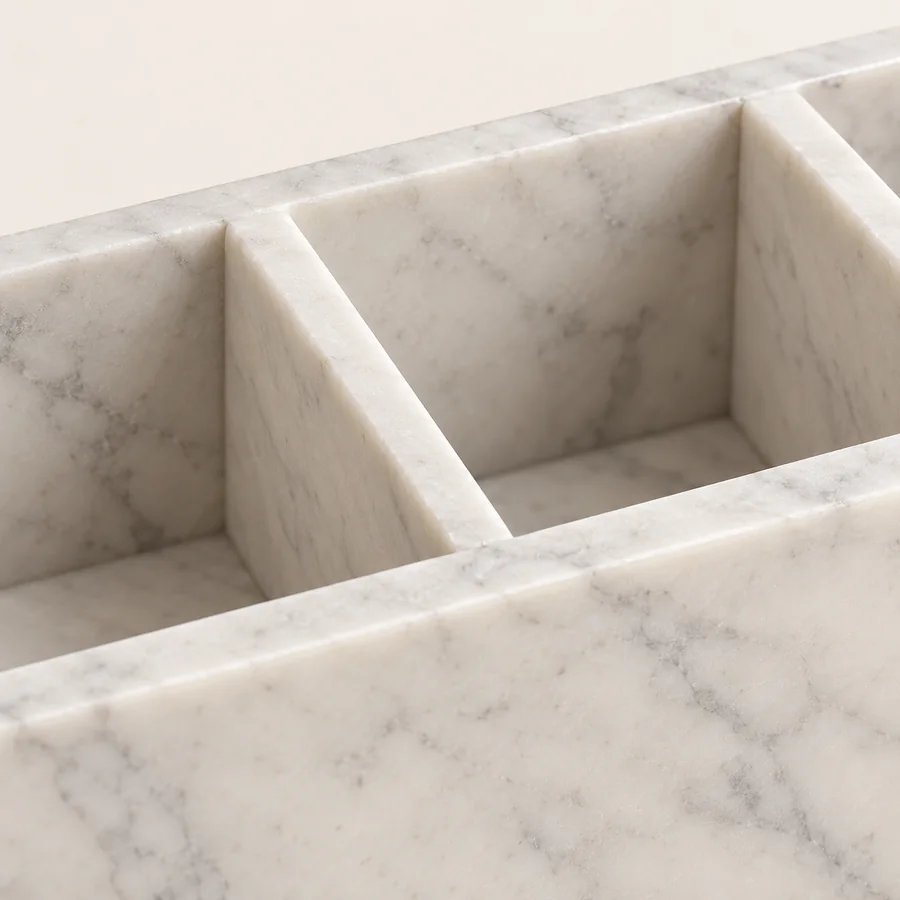
Review one divider and its connection to the box
The close illustration concentrates on one of the three internal dividers. Request a plan and section showing the divider edges, the base relationship and the transition into the outer walls. Agree the construction method appropriate for the selected marble instead of inferring a one-piece carving or joint detail from the rendering. Generated shadows do not establish exact divider thickness, completed internal surfaces or sealed compartments. Keep the approved internal drawing with the overall dimensions if you request changes to the compartment size or finish.
Decide how the packets will sit and remain visible
Use a mock-up with the actual packets to compare upright, flat or another expressly intended arrangement. Identify which labels need to remain visible and how much clearance is required to grasp an item. The stone walls may obscure lower printed information even when a packet fits within the compartment. Have the maker review the usable depth and access around the proposed contents. The generated view does not demonstrate a tested retrieval arrangement or guarantee that every packet remains easy to identify from your normal counter position.
Confirm storage treatment and food-contact requirements
Direct food contact is not certified for this proposed design. Describe the actual contents and have the maker confirm the stone treatment and intended contact before use. Until those details are resolved, use a suitable removable liner for food displays as advised for the specific arrangement. The open box should not be treated as airtight, moisture-proof or a way to extend tea freshness. Keep the contents’ packaging and storage requirements with their supplier’s instructions. A polished surface does not establish those storage properties or a certified food-safe finish.
Plan the long footprint within the tea station
Mark the proposed outside dimensions on the actual counter and check access to all four sections. Consider the normal approach direction and the clearance above the stone for removing packets. Leave the intended position clear of exposed counter edges and use a suitable level supporting surface. Heat resistance is not certified for the proposal, so keep hot cookware on a separate rated trivet. Confirm the finished stone weight and any removable furniture-contact pads appropriate to the counter, including whether those components are supplied with the organiser.
Choose marble for repeated sections and keep handling simple
Representative white-marble references can help you compare natural markings across the long walls, base and dividers. Review the material with the counter finish and packet colours, then agree the desired surface finish and acceptable variation. The generated white box does not identify an exact block or final grain pattern. Empty every section before moving or cleaning the organiser and lift the broad body as directed by the maker. Avoid using a divider as a carrying grip, and let the empty stone dry before returning the approved contents.
Request four compartments around the measured packets
Send the packet dimensions, preferred grouping, intended location, quantity and delivery postcode through a four-section marble tea-organiser enquiry. Confirm final usable spaces, construction, stone treatment, finish, supplied components, price, production timing, packing and delivery. Images are AI-generated design proposals rather than photographs of stocked or tested organisers. Follow the maker’s cleaning guidance and wipe oil, turmeric, tea and acidic spills promptly, with the Natural Stone Institute general care guide providing supporting marble advice.
Compare a round display block and a raised platform
The bottle-stopper display block has five separate vertical holes in a low round form. The marble cup display riser proposes a round platform on three short cylindrical feet. Review each design’s intended contents, contact requirements and confirmed dimensions separately before choosing accessories for a custom tea or kitchen counter.


Reviews
There are no reviews yet.